
Darkness
Scapegoating feels satisfying, but it delays reckoning with inconvenient truth.

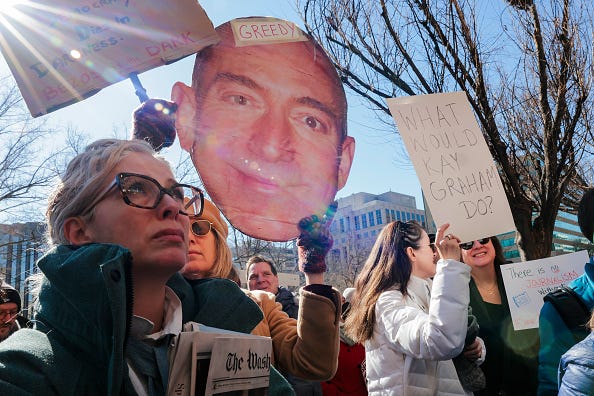
Something terrible happened yesterday: the absolute gutting of The Washington Post, once one of the world’s great newspapers. With a stroke of the pen, 300 editorial employees were out of a job. It was a blow to the community, the profession and the already tenuous future of democracy.
Something else terrible happened: a nearly universal assignment of blame that furiously and truthfully eviscerated the paper’s repulsive owner, Jeff Bezos. The indignation was righteous — and also borderline delusional.
New Yorker: “How Jeff Bezos Brought Down the Washington Post”
Ashley Parker in The Atlantic: “We’re witnessing a murder. Jeff Bezos, the billionaire owner of The Washington Post, and Will Lewis, the publisher he appointed at the end of 2023, are embarking on the latest step of their plan to kill everything that makes the paper special.
The Nation: “Jeff Bezos’s Destruction of ‘The Washington Post’ Is a Disgraceful Plutocratic Crime”
Political blogger Jeff Tiedrich: “What the fuck, Jeff Bezos? Democracy – and the Washington Post – dies up the oligarchy’s ass.
Martin Baron, former Post executive editor, enumerating “ill-conceived decisions that came from the very top — from a gutless order to kill a presidential endorsement 11 days before the 2024 election to a remake of the editorial page that now stands out only for its moral infirmity. Loyal readers, livid as they saw owner Jeff Bezos betraying the values he was supposed to uphold, fled The Post. In truth, they were driven away, by the hundreds of thousands.”
Oh, they were all too correct dismissing the majestically vulgar billionaire as a corrupt, cowardly accessory to Trumpian evil and traitor to his own supposed ethos of Democracy Dies in Darkness. In the past few years, after riding in on a white steed to save the money-hemorrhaging property from the Graham family, he revealed the Black Knight within. The order to spike an endorsement of Kamala Harris in the 2024 presidential election. The pivot in the opinion page’s focus on the MAGA-friendly “defense of two pillars: personal liberties and free markets.” Those are Bezos’s own words. And now, he who has spent a decade and hundreds of millions of dollars keeping the paper on life support, is pulling the plug halfway out of the socket.
Pretty gross, not to mention infuriating. But let’s not stumble in the dark. The salient point is that it was his initially-heroic but ultimately futile bad investments in the Post that had simply delayed the inevitable.
Under the Graham’s, it was losing hundreds of millions of dollars a year in the pitiless onslaught of the Chaos Scenario. This was the term I coined 20 years ago in magazine articles and a subsequent book to describe the last days of the media epoch, when digital tools and the internet triggered the fundamental economic law of supply and demand. Back in the day, newspapers were essentially monopolies in every market they served. Because of the insane barriers to entry for production, transportation and payroll costs, they had little competition and absolute leverage over advertising rates. For three centuries, short supply and steady demand built their vast fortunes. They enjoyed, as the saying went, “a license to print money.” But in the 21st century, the license has long since been revoked. Newspapers found themselves having to split up essentially the same fixed pool of advertising dollars with every blog, website and TikTok — literally 10s of millions of competitors — all built with spare change. The laws of economics now have publishers under heel.
Furthermore, it’s actually twice as bad as that. Now that Facebook and Google (who create no content whatsoever) swallow up half of the world’s advertising budget, newspapers are sharing much less with much more — while also losing their ability to demand high ad rates. Yes, three ruinous and certainly fatal conditions. In the midst of the chaos, the newspaper industry has shrunk by 50%, with TV, cable, magazines, radio, records and Hollywood right along with it. It’s all been so obvious for so long. Yet, unaccountably, the central problem I first published in 2005 has been very slow to sink in.
Even Marty Baron himself, in an interview I did with him in 2014, got quite peevish when I raised the chaos scenario.
“It’s far from the Titanic. I think we’re doing very well. … I don’t think we’re in a death spiral. I think the entire industry is reinventing itself. ... We intend to experiment every which way. And I expect that we will succeed. … Just because we don’t have all the answers today doesn’t mean we won’t arrive at answers in the future.”
In his denialism, Marty was in good company. My explication of the blindingly obvious was also dismissed, and/or ridiculed, by Sir Martin Sorrell, then CEO of WPP, the largest advertising holding company; George Schweitzer, executive VP of CBS; Chad Hurley, founder of YouTube(!); Microsoft’s Bill Gates and many, many others — including all of my friends in journalism. Including colleagues at my public-radio show On the Media.
“But we can’t lose journalism!” was the argument I heard the most. “It’s crucial for democracy.” The notion that the media economy — a 300-year-long bonanza for publishers, advertising and audiences and guarantor through relentless watchdogging of democracy — itself was unsustainable was seemingly ungraspable. The other assertions in the litany of denial were: 1) “They just have to come up with new technology,” 2) “They just have to find a new business model,” and 3) “Look at all the all-digital publications, Huffington Post, BuzzFeed, The Daily, Patch, Yahoo! News.”
Okay, let’s start with that last one. Those publications also have squandered fortunes, burning investor billions in an absolute furnace of wishful thinking. They built audiences, yes, but readers’ attention in a mega-glut by definition had plummeting value to advertisers. Even though contributors suddenly were paid little or nothing, the overhead costs were unsupportable.
As for a new business model right around the corner, I examined 17 sources of revenue — from subscriptions, micropayments and the public-broadcasting model to dating services and cruises — but none of them singly or combined came close to replacing the vanishing ad dollars. Many of the revenue streams, like so-called “native advertising” and affiliate marketing, were at best ethically dubious. The category I called “patient billionaires” (tycoons who could afford to weather losses) was especially seductive for some people — people who forgot that billionaires tend to have conflicts of interest and also tend to be dicks. Government funding was often mentioned, too, despite being patently idiotic. It envisioned watchdogs in the employ of the watched.
And the idea that salvation was to be found through technology — seriously? It is the gutters of digital technology that are flooded with media blood. When Bill Gates told me I was being too doom-and-gloomy, I asked him where the solution lies. A puckish grin crossed his face as he said, “Software.” It reminded me of the scene in The Graduate, when a family friend buttonholed Dustin Hoffman to share his vision of a happy prosperous future, “One word: plastics.”
The tragic fact is, there was no solution to the fundamental supply-and-demand problem 20 years ago and most likely never will be. It’s not called an economic law for nothing. Shall we also believe that some 20-year-old Stanford genius will come up with a solution for gravity?
So, just to recapitulate, yes, fuck Jeff Bezos. The man cowers in the dark trying to protect his government contracts in cloud computing and space travel while also expensively rebuilding his young wife with aftermarket parts. A billionaire dick if ever there was one. But he is not the problem here. He was naive and charitable until he wasn’t. The problem itself is insoluble. It’s true, we do need a robust press to enable a functioning democracy. But nothing is guaranteed, no matter how dire the circumstances. We also need a cure for cancer, a cooler planet, a rational electorate and justice.
Instead, our country and the world are engulfed in darkness, and the only means to illumination are also in tragically short supply: courage, selflessness and truth. As if.
Oh, how I wish you were wrong. But you're not.
Well, that sure cheered me up.
Not.
But ... yeah.
We're fucked.