
Defining News Down
The spike of journalistic worst practices in the Click Age.

Editor’s note: This is the second post in a three-part series, “Media Literacy 3.0,” examining how radically consumer, publisher and advertiser behavior has devolved in the downward Chaos Scenario spiral of the news industry. The first installment, Escape to Planet X, ran last week.
This is not about sportswriting, particularly. But that is where we shall start.
There was a time, before news went overwhelmingly online, when sportswriting involved reporting on sports. Game narratives, injuries, roster changes, competitive dominance and abject failure. In short: things that had happened or were in the process of happening. On the opinion side, there were featured columnists who brought to bear their ostensible insights and often sparkling writing to offer more dimension to stories a step or six beyond the contests themselves. Then there was sports radio, which was and continues to be an endless barrage of opinion, knee-jerk reaction and, above all, certainty tethered to little or nothing in the realm of fact. The civilian callers, even more reflexive in a near total vacuum of knowledge, were the foils in the 50,000-watt dramas simulating two drunks in a bar.
Well, in the internet-mediated world, the talk-radio model has swallowed the “reporting” function of sports coverage and discharged it along the lines of cyclosporiasis. The industry is dominated by endless clickbait speculation, not only with little or no basis in evidence but no underlying reporting whatsoever. To (probably unnecessarily) advance the analogy, it is the product of thousands of click-starving bloggers blowing it out of their asses.
Dozens or hundreds of such trade “proposals,” proposed solely by the writer himself, are published every day. But, as they say in infomercials, “Wait! There’s more!” Because once such a speculative post has made it online, other click Pac-Men essentially swallow it whole and then, once again, digest it, with the original speculator cited as the “source” of the rumor.
The source in this case was the venerable Ballpark Buzz, and the fabled scribe Micah Storms. Very often, to add a patina of literal accuracy, the headlines will use some deceptive wordplay.
Linked, that is, by the unfounded delusion of a hypester and literally by the weblink, such as I’ve helpfully provided here.
Mind you, I’m not just cherry-picking. I’m not describing a few bad apples to smear an otherwise nourishing barrel. This is the whole rotten, stinking, putrefied crop. Inexplicably, I am a big follower of professional sports, and as so have interest in what Philadelphia teams are up to in the trade, free-agency and draft seasons. My feed just oozes with mock-drafts that never, ever predict accurately — because the sheer number of variables and unknown deliberations of the teams make such a feat impossible. I’m also constantly fed trades that are figments of every imagination in the putzosphere, and roster battles for football players who have yet to don pads in the preseason, which means nobody, including the teams’ management, has any idea what opening day will look like. Hence the pandemic triggered by the parasite called “commercial imperative.” Get out of my way. OUT OF MY WAY. Gotta get to the bathr … oh, no.
So perhaps you say, “Oh, Bob. It’s just sports. Who cares?” Answer #1: As someone who cherishes fundamental honesty in journalism of every kind, I care. A lot. Answer #2: It is by no means a sin only of sportswriting. The speculation squits have spread to all corners of journalism. Coverage of everything from politics to war to climate to medicine is now infected with reporters’ informed of misinformed opinions, off-the-cuff guesswork and various other estimations about a near future that hasn’t happened yet. Every day, the past few included, brings a relentless fusillade of speculation, interpretation and pointless guesswork in place of news.
Raw Story, July 14, 2026
The New York Times, July 14, 2026
San Diego Union-Tribune, July 16, 2026
Southern Living, July 16, 2026
New York Magazine, July 16, 2026
You know what? It probably isn’t time for you to be growing your own lettuce. That’s my opinion, based on the difficulty, inconvenience and lifestyle change required to suddenly start growing your own lettuce. What a vacuous premise. But more to the point, as in all of the above examples, everything that these publications deemed worthy of the “could” and “might” views of the future by definition are exactly as accurately phrased as “might not.”
As they say, anything is possible. The Pillow Man might be the next governor of Minnesota. The New York Jets might be a contender. There might someday be a perfume called Cow. But what is learned by hearing about possibilities when the world of events is overflowing with the “fucking absolutely” that don’t get covered because news organizations haven’t the resources to cover them. So they fill their stories with speculation, requiring no time or travel budget but merely the intuition — backed by varying degrees of actual information — about a scenario that may or may not come to pass.
Obviously, there is a place in properly labeled news analysis for contextualizing today’s events by examining their impact on tomorrow — in the same way that Crest is an “effective decay-preventive dentifrice that can be of significant value when used in a conscientiously applied program of oral hygiene and regular professional care.” Which is not the same as “Crest prevents cavities.” Alas, the ease of belaboring the obvious and/or alarming the masses and/or dreaming outloud has turned news columns into a sort of predictions market for hypotheticals, which is no substitute for reported news. Except that in the digital world it is exactly a substitute for reported news.
Jewish Telegraphic Agency, July 16, 2026
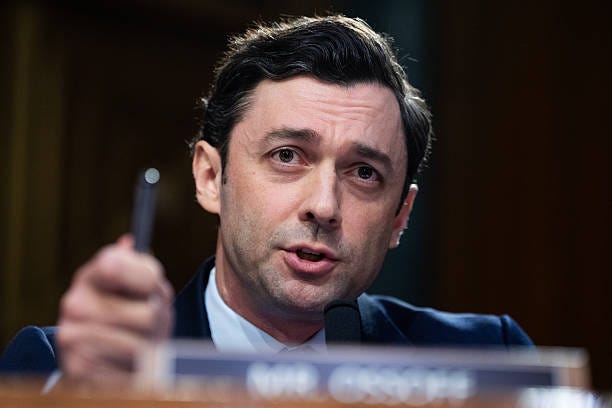
Oh, yeah? Again, it’s possible, I suppose. Like cold fusion and supply-side economics and contented adolescents. If this Ossoff idea captures your imagination, and you don’t mind being disappointed, but you also don’t want to squander your hopes on a longshot, it might be time to grow your own lettuce.
Next week: Part 3 of “Media Literacy 3.0”: The Nose Hair Storm.
You had me at your impeccably exact wording of the ages-old Crest “decay-preventive dentifrice” mantra that was drilled (like dentists do) into our childhood heads by too many TV toothpaste commercials. (Maybe that’s why I’ve used Colgate for decades, though I’m sure “my” brand must’ve slung similar factless mumbo jumbo, too.)
Sadly, the factless and unreported “news” that too many of our countrymen and women swallow whole isn’t merely rotting their teeth — it’s rotting their brains. Thanks for trying to hold the mirror up to them. Alas, I haven’t much faith in their ability (or worse, in their desire) to recognize the problem staring them back in the face — willful ignorance and apathy.
🧵If it’s written by Bob Garfield, it’s got to be good.
But not only good. More importantly, it’s got to be true!
~•~•~
It’s got to be like one of those old print advertisements in The New Yorker, “When the name is E. F. Hutton, people listen.”