
Mars
Why the red planet has the high arts walking the Green Mile.

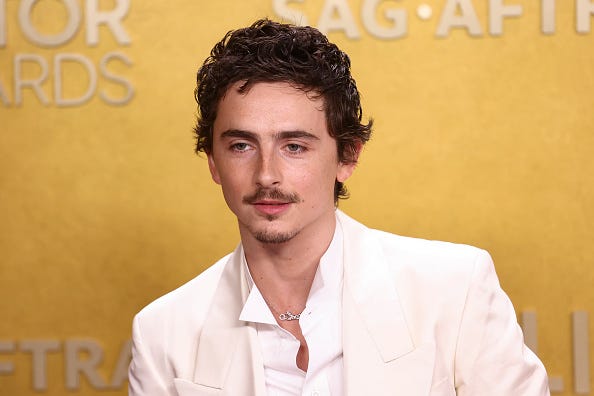
The world is in flames, at war and in a mindless death rage on four continents as a madman vandalizes civilization because he can’t get any respect, so naturally all eyes are focused on Timothée Chalamet.
He’s the scrawny young actor with the pubescent mustache and reputedly august artistic gifts, a belief about which I have no opinion. (I’d given some thought to seeing his much-lauded performances in Dune Part 2 and Marty Supreme, but that would have broken my rule about sitting through any movie that lasts longer than Ramadan.)
Anyway, a week ago, Chalamet was on a podcast with Matthew McConaughey — presumably to talk about the mystery of their rhyming last names — and he happened to blurt out an inconvenient truth about his dedication to the cinematic art: “I don’t want to be working in ballet, or opera, or things where it’s like, ‘Hey, keep this thing alive, even though like no one cares about this anymore.’”
That’s what he said. What the world heard, evidently, was: “The only real pizza is Hawaiian with extra pineapple, and also Hitler was right.” The outrage was instantaneous, regarding his honest aside as some combination of blasphemy, philistinism and arrogant disregard for artistic genres that have existed for centuries — partly, but not solely, because audiences of Puccini and Jean-Philippe Rameau had no expectations of car chases or alien starships. They relied on mere virtuosity and tights. Anyway, the denizens of Lincoln Center about shit themselves.
Mezzo-soprano Isabel Leonard had this to say: “To take cheap shots at fellow artists says more in this interview than anything else he could say. Shows a lot about his character. You don’t have to like all art but only a weak person/artist feels the need to diminish in fact the VERY arts that would inspire those who are interested in slowing down, to do exactly that.”
Brazilian ballet dancer Victor Caixeta accused Chalamet of being a soon-to-be-forgotten non-entity: “Ballet and opera have survived for centuries. Let’s see if your movies are still watched in 300 years.”
New York City Ballet principal dancer Megan Fairchild was simply gobsmacked by Chalamet’s presumption, as if he blessed the movies with rare talent that he elected to withhold from the lesser, loser genres. “Timmy, I didn’t realize you were a world-class dancer or opera singer who simply chose not to pursue it because acting’s more popular! Ballet and opera aren’t niche hobbies people opt out of for fame. They’re disciplines you can only enter if you have the rare ability for them in the first place.”
Even President Donald Trump weighed in, as he returned from the 13th-century BC having personally ended the Trojan Wars, “He has potential, but he hasn’t shown the fire that voters are looking for.” Some have suggested that Trump was confusing Tim Chalamet with former Republican presidential candidate Tim Pawlenty, who bears a passing resemblance to the actor. Another possibility is that this entire paragraph was created with ChatGPT and may contain errors. Another possibility is I’m just filling space to set you up for this very true story about my wife.
Milena was for years on the Board of Serbia’s National Theater, which staged not just drama but opera and ballet. In her tenure, most performances were sold out. How? Why? Ah, because in Serbia the arts are paid for by the government. Ticket prices are nominal, the troupes are talented and the main theater has only about 500 seats. She pities her colleagues almost everywhere else in the world, who depend on wealthy donors to build an endowment. She likes to talk about the gilded age, when the Vanderbilts and the Astors, arch rivals in New York society, built dueling opera houses and companies to dominate the city’s cultural scene.
“Now,” Milena has been saying for years, “billionaires don’t go to the opera. They go to Mars.”
Meanwhile, her late dear friend, Ivan Tasovac, when he served as director of the Belgrade Philharmonic, told her how difficult it was in a post-Communist society to find private donors to make up for diminishing state subsidies. He told her about one tycoon who refused to endow the philharmonic until Tasovac had a brainstorm. “I called him,” he told Milena, “and said if he doesn’t underwrite the philharmonic, I would send his wife two free subscriptions for the next five seasons.” Such elegant extortion! Tasovac knew it was impossible to listen live to Bartók’s Concerto for Orchestra and watch the Partizan-Red Star soccer match at the same time. “Enjoy your weekends!” he told the oligarch. A big check arrived within three days.
Around the globe, the donor class is dwindling to nothing. The Metropolitan Opera in the past two years has tapped its once $300 million endowment for $70 million to cover operating expenses — which is like taking out a home equity loan to pay the utility bills. Thus has General Manager Peter Gelb gone dialing for dollars.
“What we really need,” he told The New York Times, “is one of these triple-digit billionaires to give us a billion dollars.”
So far, no takers. Apparently unaware of Milena’s delicious quip, Gelb approached Elon Musk for a handout. No dice.
At one point, Gelb even courted Elon Musk, promising only half jokingly to help the tech billionaire produce an opera in outer space if he gave money to the Met.
“I wrote to him and I said, ‘I would love to talk to you about the Met,’” he said in a recent interview. “‘We would love to be part of your Mars expedition, and we’ll produce an opera for you on Mars.’” Musk did not respond.
Maybe he should have tried the free-subscription gambit. But desperate times evidently call for morally indefensible measures. Having dug so deeply into the Metropolitan Opera’s principal to keep the lights on, Gelb was reduced to digging just as deeply into principle — cutting a deal with the Kingdom of Saudi Arabia for an estimated $100 million. That to the horror of patrons who do not wish to be financially linked to grotesque human-rights abuses, including the murder of an American journalist. The Saudis! Presumably because the Gambino Family hated the commute from Brooklyn.
Which brings us back to Timothée Chalamet. He hurt people’s feelings, for sure. He created a tempest in a pisspot by telling a sad truth that neither McConaughey nor anyone else had solicited his viewpoint on. It was one of those sodium pentothal moments, where you can’t locate your off button for candor. Oops. In tennis they call it an unforced error. In 21st-century social culture, they call it one baby step from cancellation.
But here’s the thing. Brazilian dancer Victor Caixeta was right, but much, much more right than he imagined. “Let’s see if your movies are still watched in 300 years,” he said, as if this were throwing real shade. What he should have said was that the movie industry is about two baby steps behind the opera. Its financial model has been ravaged, first by digital tools, then by video games, then by Covid, now by ruinous glut and next by AI. Actor salaries are plummeting, distribution is already limited to about five streaming platforms who hold all the leverage in negotiations. Three hundred years from irrelevance?
How about 10? The actor’s nightmare has always meant forgetting to learn your lines. Now the nightmare is just the future.
Each month, i think "you know, i could probably use that $5.00 for something else." Then i read one of these missives and remember that it is money very well spent. 🙂
Yes, the SS Hollywood has hit the iceberg and is now taking on water while listing heavily to port. The final blow to sink the ship may be AI, but before that digital juggernaut can stomp the industry like Godzilla wading through Tokyo, we're to be visited by the Plague of Verticals.
"WTF," you might ask, "are 'verticals?'"
Don't ask ... well, okay: ask and ye shall receive:
https://nofilmschool.com/what-are-verticals
Just don't say that I didn't warn you.