
Medical Mysteries
When an annoying minor symptom is prelude to even more annoying minor symptoms.

On February 16, the dashing American journalist Robert G. sat with friends at a lovely New Belgrade restaurant called Meze. Greek. Cheerful. Delicious. He expected an otherwise uneventful day.
He could not have been more mistaken. Some thirty minutes into the feast, he felt a slight scratchiness in his throat. Perhaps the restaurant smoke (this was in Serbia, where smoking is mandatory) was an irritant. He thought little of it. But two hours later, the rawness had mutated into a slight dry cough.
Here you must remember the dramaturgy of Chekhov: “A musket seen over the mantelpiece in the first act will discharge in the second.” If you’ve been to the movies or watch late-night TV commercials, you well understand that a cough at any point presages tragedy, either from consumption or mesothelioma. Yet Robert G. blithely wolfed down fried feta and 14 separate eggplant dishes without heed to any malady. Then, again, cough, cough.
Nobody even noticed.
The next three days were more of the same. A dry, unproductive cough. This led to self-medication with over-the-counter Serbian cough syrup, which tasted like high-end apricot brandy or low-end absinthe. Then, on February 20, with his small white dog Henry G. and two months of dirty laundry, he traveled 4,400 miles to the Empire of Magastan. When he arrived, the minor cough had taken a frightening turn: Occasional sneezing. And a slight malaise.
He shrugged it off. He was on an Uber ride from JFK International to his daughter’s house in north central New Jersey or south north New Jersey, a fare that would necessitate a second mortgage. And on the cool afternoon, he was more focused on his finances than why he was opening the rear windows. He was suddenly feeling hot, but, he thought, not of fever. As the outside air washed over him, he was somehow moved to address the driver:
“Sir, I wish you to understand the true principles of government; I wish them carried out, I ask nothing more.”
Strangely, neither Robert G. nor the driver recognized those as precisely the last words of President William Henry Harrison, who got the sniffles during his 1841 inauguration and died only a month later. It was an eerie moment, and an ominous one. Then, in suburban Scotch Plains, came an even more shocking development. Robert G’s daughter is a physician. When she heard his wheezy breathing, and realizing he lives with “mild” COPD, she fetched her stethoscope to listen to her father’s lungs, whereupon — most likely brokenhearted by her Daddy’s quiet stoicism — she uttered her fatal diagnosis: “You’re fine.”
Tragic. Little could she know that “You’re fine” were not the last words of Pedro II, Emperor of Brazil, Calamity Jane, Rene Descartes, Geronimo, Franz Liszt, Oral Roberts, Mister Rogers, Harriet Tubman, Leo Tolstoy and Lawrence Welk. Those were the last words of the doctors of Pedro II, Emperor of Brazil, Calamity Jane, Rene Descartes, Geronimo, Franz Liszt, Oral Roberts, Mister Rogers, Harriet Tubman, Leo Tolstoy and Lawrence Welk. An opportunity for hospitalization and large dosages of calming opiates had been squandered. When the time to walk the dog arrived, he tried to say “Come on, Henry.” But his voice was too hoarse to be understood. Sensing trouble for his beloved master, Henry strolled into the next room, jumped on the sofa, and fell fast asleep.
It’s uncanny. How do they know?
Three days of mild discomfort later, Robert G. — like a sea turtle laden with eggs, or an unemployed college graduate — felt an urgent impulse to return home. By that point, literally speechless with laryngitis and heroically battling a slight headache and vague feeling of feverishness, he boldly stuffed his luggage and Henry the Small White Dog into his car and began the southward journey to their home in the Empire’s capital, Washington, DC. This was Day 7. The symptoms were persistent, but the musket remained on the wall unfired. He gave little thought to his fate.
Of such denial, of course, catastrophe is born. Think of Mimi in La Boheme and Violetta in La Traviata. They sang for nearly three acts before finally succumbing to what began with a scratchy throat and tight, unproductive cough. “You’re fine,” their doctors probably told them. (Apparently, Puccini and Verdi cut those scenes from their operas.)
The trip to Washington is what medicine calls “somewhat unpleasant,” taking Robert G. into days 9 and 10 — both days of hacking cough, ongoing slight headache and the discharge of sputum. Yes, the infection had progressed … and so had our hero’s awareness of the stakes. On Tuesday, after a night of sleep disturbance, he at last began to understand what possibly faced him: the prospect of singing “Parigi, o Cara” with Alfredo and then being lifted lifeless by the tenor as the audience chokes back tears. Robert G. had also seen both Forsyte Saga miniseries. In the morning, after a night of violent coughing, he knew what to look for in his handkerchief. Sure enough, there it was: a red spot of blood.
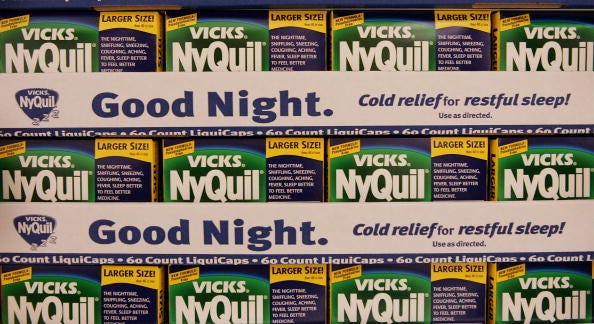
Or so he first thought. It was actually NyQuil, which he’d been pounding like Pete Hegseth and Brett Kavanaugh at Happy Hour. Nor did he stop doing so. Thus ending the confounding medical mystery. As Day 10 dawned, so did his vision of the future: another week of this bullshit, at least. Which is insult heaped upon injury. The collapse of democracy and rule of law is bad enough.
It’s much worse with a cold.
I'm recovering from pneumonia. I thought my chest discomfort was a result of our political maelstrom. Turns out it was that, and walking pneumonia. The pneumonia is healing, our country is not. Bob, feel better. So sorry you were ill.
OMG! I have a cold too! I hope you feel better soon, Bob.