
Pharisees and Fallacies
The fatal human inability to account for change.

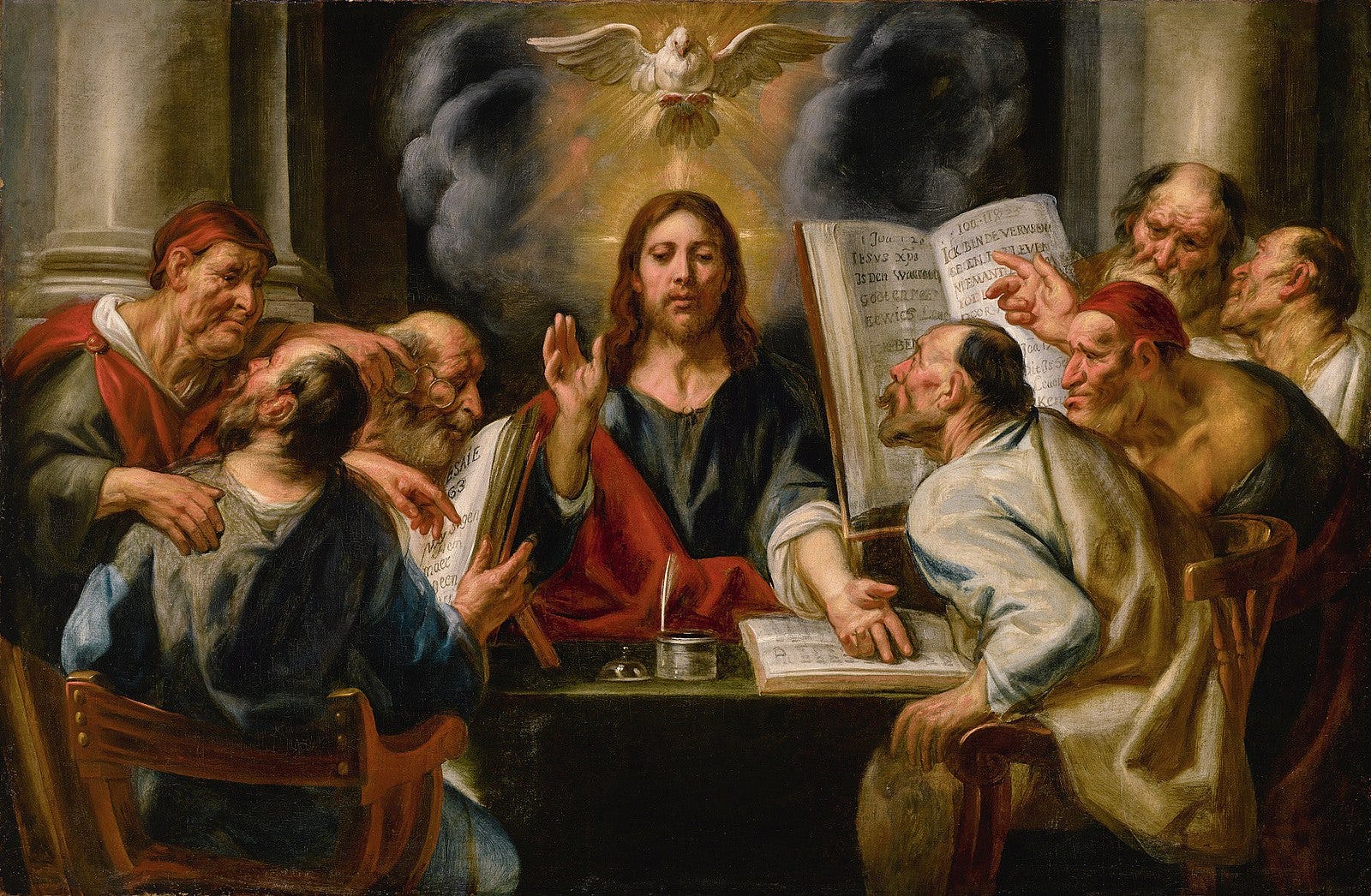
Jesus Christ was apparently not a big fan of the Jewish sect called the Pharisees. As he is quoted in Matthew 23:13, 27–28:
Woe to you, teachers of the law and Pharisees, you hypocrites! You are like whitewashed tombs, which look beautiful on the outside but on the inside are full of the bones of the dead and everything unclean. In the same way, on the outside you appear to people as righteous but on the inside you are full of hypocrisy and wickedness.
The wickedness was their alleged haughtiness, ostentatious piety and elitist trappings, not to mention political opposition to the revolutionary teacher Christ himself. Their enduring legacy, though, is a Living Law, a code not blindly adhering to the Torah, but instead crediting oral traditions and the complexity of life — not unlike Christ’s own teachings — to evolve along with the society. Hence the centuries of Talmudic thought interpreting the law from the perspective of ever-changing modernity. (Not that the Pharisees were necessarily the far-left, Soros-backed woke. The New Testament portrays them as more harsh and inflexible with their Living Law than their High Priestly nemeses were at punishing Torah infractions.)
A rough comparison would be the American originalists who subscribe to a Living Constitution and reject retrograde literalism. Their ideological foes are the sect of so-called “New Originalists,” who treat the 18th-century perspective of men clad in breeches and tri-corner hats as sacred and immutable. (See: “the right to bear arms.”) The late conservative Justice Antonin Scalia famously wrote: “The Constitution that I interpret and apply is not living but dead, or as I prefer to call it, enduring.”
Any other approach is derided as liberal “judicial activism,” which is a modern way of saying “hypocrisy and wickedness.” To Scalia and his followers, Living Constitution proponents are hypocritical, hardline Pharisees, whom, by the way, Christians blame for conspiring with and/or encouraging the Romans who crucified Christ. So there.
All of which is to say, people not only have trouble agreeing on good vs. evil, but also coming to terms with the passage of time. In the many existential crises humanity faces, too many humans are hopelessly and tragically unable to process reality beyond the recent past. Furthermore, we cannot imagine that present blessings could ever be finite. Because how could they be? How could Mother ever die? I need her. I have never known life without her. Me? Motherless? It’s simply not possible.
Yes, it is.
I’ve witnessed this phenomenon most vividly with the collapse of the media business model, which I saw coming 20 years ago and described in print as “The Chaos Scenario.” It predicted the end of print, broadcast — and therefore professional journalism — for the simple reason that the internet had dismantled the supply-and-demand equilibrium that had underwritten three centuries of ad-supported media. Not only at the time, but for the entire 20 years right up until about five minutes ago, I was dismissed as a panicky Chicken Little. Because, come on, there must be a solution!
How could journalism ever die? We need it. We have never known life without it. Us? Without watchdogs? Democracy needs them. It’s simply not possible.
Yes, it is.
If you study the science and politics of climate change, you see the same kind of irrational optimism. Let’s just stipulate that for a long time, inaction resulted from the frog-in-the-pot syndrome. Since the Industrial Revolution, the atmospheric effects were so slight and incremental that we didn’t notice them until too late. But that excuse has long since been impeached. Everybody notices extreme weather, and for 50 years we’ve been awash in data about thinning ozone, greenhouse gasses, warming temperatures, melting ice caps and rising sea levels. The planet is cooking in sunlight and unreality, and the frog is faring poorly.
On the one hand are the denialists, who throw snowballs on the floor of the Senate to mock the notion of global warming and pontificate about natural climate cycles that wax and wane. Human-created climate crisis? Piffle. On the other hand are can’t-be-ists, who, like the traumatized child of a dying old lady, cannot comprehend the extermination of humankind and so rationalize miracles. Count in this group 90% of the nations of the world.
I’ve already bragged about my “Chaos Scenario” soothsaying. So may I now also promote my Five Principles, dictums that have immeasurably benefited me in my own personal life? As the internet clickbait says, “Number 5 is genius!”
Floss regularly.
The secret of happiness is low expectations.
Children are stupid. Even smart ones.
Don’t ever eat airport food or drink with Russians.
Conditions change.
Like an infant who sees a pretty shape and screams bloody murder when it inexplicably goes out of view, we as humans impute permanence not to dangling mobiles but to conditions of the world. This invariably leads to denial and disappointment when those conditions vanish. An expert on this phenomenon was the late Marie Antoinette. No matter how comfortable, felicitous, cherished, economically valuable and even necessary a given condition may be — no matter how horrid the consequences should it disappear — nothing is forever. Not Mother, not subsidized journalism, not a healthy planet. Because the Pharisees were on to something.
Conditions change.
This fallacy of permanence is exacerbated by its cousin, the Recency Fallacy — aka the Ebbinghaus Effect — through which recent information, learning or experience lodges in memory and assumes more importance than input and experience from the past. We are hardwired not to see the broad sweep of history going back to the ascent of man, but rather going back to our most recent memories, whether distant in hours, years, generations or lifetimes.
So now, at last, we can talk about American democracy. Independence in 1776, our gloriously aspirational constitution in 1789, the society’s gradual renovation and repair (slavery, trade unionism, suffrage, explicit human rights). For 250 years, generation after generation, we’ve inched our way toward our founding ideals. The rule of law seemed to be a constant. Inalienable rights seemed to be immutable.
How could it ever die? We need it. We have never known life without it. Me? In tyranny? It’s simply not possible.
Except, as the Washington Post sloganizes, “Democracy dies in darkness.” And darkness is rapidly descending.
Here, though, I wish to change metaphors, to quote the illustrious historians Will and Ariel Durant, whose mammoth The Story of Civilization suffered from no fallacies of recency or permanence. On the contrary. They viewed the human race as a tribe eternally on the frontier of both civilization and barbarism. The Durant analogy for this constant human struggle was the natural world:
For barbarism is always around civilization, amid it and beneath it, ready to engulf it by arms, or mass migration, or unchecked fertility. Barbarism is like the jungle; it never admits its defeat; it waits patiently for centuries to recover the territory it has lost.
Can humankind be devoured by the jungle? Yes, we can. And yes, we are.
Depressing & right on is true...
Another good one, Bob, albeit depressingly spot-on. The Durants were on to something, alright -- the jungle never admits defeat -- but I lean toward a metaphor based on the timeless battle of water against rock. Rock may be obdurately unyielding, but with time on its side, water inevitably prevails. As our rock of civilization approaches its sell-by date, eroded and battered by the waves of a new/old tribalism, the oceans -- literal and metaphorical -- are rising.
I see tRump as the new millennium Pol Pot, marshaling the forces of fear and ignorance to beat back and suppress those the MAGAt mob considers "elitists": the educated and awake (or "woke") who view the world through the lens of science, humanism, logic, and education. Combover Caligula and his mob of MAGAts have no use for all a that book-learnin'.
I never thought the Dark Ages could return ... but here they come.
PS: What's up with FF - will it ever return?